


Russian Personal and Possessive Pronouns: Личные и притяжательные местоимения

Updated: 7 minutes ago

Learning Russian pronouns is one of the first important steps towards building sentences and communicating confidently in Russian. You need personal pronouns to talk about yourself and other people, and possessive pronouns to say who something belongs to.
In this beginner-friendly Russian grammar lesson, we'll look at personal pronouns (я, ты, он, она...) and possessive pronouns (мой, твой, наш, ваш...). You'll learn how to use them, understand the difference between their forms, and practise with useful examples and exercises.
Let's get started!
1. Russian Personal Pronouns – Личные местоимения

Personal pronouns are words that we use instead of people's names or nouns. They help us avoid repeating the same names and make sentences shorter and more natural.
For example:
Анна чита́ет кни́гу. Она́ чита́ет кни́гу.
Anna is reading a book. She is reading a book.
In Russian, there are eight basic personal pronouns in the nominative case.
Russian Personal Pronouns Table
Russian | English | Usage |
я | I | First person singular |
ты | you | Singular, informal |
он | he | Masculine |
она | she | Feminine |
оно | it | Neuter |
мы | we | First person plural |
вы | you | Plural or formal |
они | they | Third person plural |
Important things to remember
1. Ты or Вы – What's the difference?
Russian has two ways to say "you".
Ты – informal, used when speaking to friends, family members, children, and people you know well.
Вы – formal, used when speaking politely to strangers, older people, or in professional situations. It is also used when addressing more than one person.
Examples:
Ты мой друг. – You are my friend.
Вы мой учи́тель. – You are my teacher. (formal)
Вы мои́ друзья́. – You are my friends.
2. Он, она or оно?
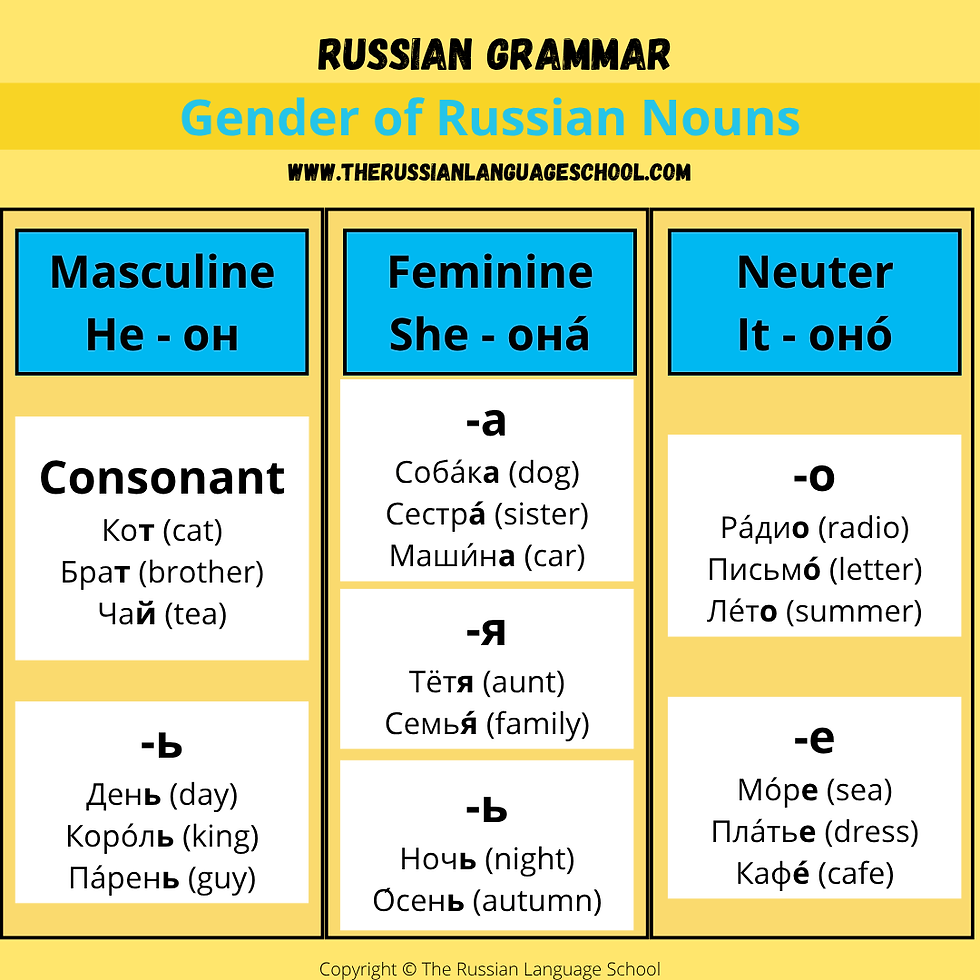
Russian nouns have grammatical gender: masculine, feminine, or neuter. The pronouns он, она, and оно correspond to these genders. If you're not sure how to identify the gender of Russian nouns, read our guide to Russian Noun Gender: Masculine, Feminine and Neuter.
он – masculine: стол (table), дом (house), телефо́н (telephone)
она – feminine: кни́га (book), ма́ма (mum), шко́ла (school)
оно – neuter: окно́ (window), ме́сто (place), мо́ре (sea)
Examples:
Это стол. Он большо́й. – This is a table. It is big.
Это кни́га. Она́ интере́сная. – This is a book. It is interesting.
Это окно́. Оно́ большо́е. – This is a window. It is big.
3. Do you always need personal pronouns in Russian?
Here's something interesting: in Russian, personal pronouns are often omitted because the verb ending already tells us who is performing the action.
For example:
Я чита́ю. – I am reading.
Чита́ю. – I'm reading.
Ты говори́шь по-ру́сски. – You speak Russian.
Говори́шь по-ру́сски? – Do you speak Russian?
Both versions are correct. The pronoun is often used when you want to emphasise who is doing something or make the meaning clearer.
2. Personal Pronouns in Different Cases
The pronouns we've just learned are in the nominative case (именительный падеж). This is the basic form used when the pronoun is the subject of a sentence.
However, Russian personal pronouns change their forms depending on their grammatical case.
For example:
Я люблю́ тебя́. – I love you.
Ты лю́бишь меня́. – You love me.
Notice that я changes to меня́, and ты changes to тебя́.
Here are the main forms of Russian personal pronouns:
Case | я | ты | он | она |
Nominative | я | ты | он | она |
Genitive | меня́ | тебя́ | его́ | её |
Dative | мне | тебе́ | ему́ | ей |
Accusative | меня́ | тебя́ | его́ | её |
Instrumental | мной | тобо́й | (н)им | (н)ей |
Prepositional | обо мне | о тебе́ | о нём | о ней |
And the plural forms:
Case | мы | вы | они |
Nominative | мы | вы | они́ |
Genitive | нас | вас | их |
Dative | нам | вам | им |
Accusative | нас | вас | их |
Instrumental | на́ми | ва́ми | (н)и́ми |
Prepositional | о нас | о вас | о них |
Don't worry if these forms look complicated! You don't need to memorise everything at once. Start by learning the nominative forms and the most frequently used forms in everyday conversations.
Useful examples
Я люблю́ тебя́. – I love you.
Она́ зна́ет меня́. – She knows me.
Он помога́ет мне. – He helps me.
Мы говори́м о них. – We are talking about them.
Ты идёшь со мной? – Are you coming with me?
3. Russian Possessive Pronouns – Притяжательные местоимения
Possessive pronouns show ownership or possession. They answer the question Чей? Чья? Чьё? Чьи? (Whose?).
For example:
Моя́ кни́га. – My book.
Твой телефо́н. – Your phone.
Его́ маши́на. – His car.
Russian possessive pronouns agree with the noun they refer to in gender, number, and case. This is similar to how Russian adjectives change their endings depending on the gender and number of the nouns they describe. Learn more in our guide to Russian Adjectives in the Nominative Case.
Let's look at the most common Russian possessive pronouns.
Russian Possessive Pronouns

There is also the reflexive possessive pronoun свой, which means one's own. We'll look at it later in this lesson.
4. How to Choose the Correct Form of Мой (My)
One of the most common questions beginners ask is:
Why are there four different ways to say "my" in Russian?
The answer is simple: you need to look at the gender and number of the noun that follows the pronoun.
Let's take a closer look.
1. МОЙ – Masculine nouns
Use мой with masculine singular nouns.
Examples:
мой кот – my cat
мой дом – my house
мой телефо́н – my phone
Это мой кот. – This is my cat.
Это мой дом. – This is my house.
2. МОЯ – Feminine nouns
Use моя with feminine singular nouns.
Examples:
моя́ кни́га – my book
моя́ семья́ – my family
моя́ маши́на – my car
Это моя́ кни́га. – This is my book.
Это моя́ семья́. – This is my family.
3. МОЁ – Neuter nouns
Use моё with neuter singular nouns.
Examples:
моё окно́ – my window
моё ме́сто – my place
моё письмо́ – my letter
Это моё окно́. – This is my window.
Это моё ме́сто. – This is my place.
4. МОИ – Plural nouns
Use мои with all plural nouns, regardless of their original gender. Need a refresher on how Russian nouns form their plural? Check out our lesson on Russian Plural Nouns: How to Form the Plural in Russian.
Examples:
мои́ друзья́ – my friends
мои́ кни́ги – my books
мои́ де́ти – my children
Это мои́ друзья́. – These are my friends.
Это мои́ де́ти. – These are my children.
Remember: Always look at the noun, not the person who owns it!
For example:
A man can say моя́ кни́га (my book), because кни́га is feminine.
A woman can say мой дом (my house), because дом is masculine.
The form of the possessive pronoun depends on the noun, not the owner's gender.
5. His, Her and Their in Russian – Его, Её, Их
Now let's look at something that makes Russian possessive pronouns a little easier!
The words его́ (his), её (her), and их (their) never change their form.
Unlike мой, моя, моё, and мои, they are invariable (indeclinable).
This means you can use them with masculine, feminine, neuter, and plural nouns.
Look at these examples:
ЕГО – His
его́ кни́га – his book
его́ дом – his house
его́ ме́сто – his place
его́ де́ти – his children
ЕЁ – Her
её кни́га – her book
её дом – her house
её ме́сто – her place
её де́ти – her children
ИХ – Their
их кни́га – their book
их дом – their house
их ме́сто – their place
их де́ти – their children
Notice that the pronouns remain exactly the same in all these examples.
Important: Его, её, and их are also unchanged when used before nouns in different grammatical cases.
For example:
Я зна́ю его́ бра́та. – I know his brother.
Я зна́ю её́ сестру́. – I know her sister.
Я говорю́ с их учи́телем. – I am talking to their teacher.
The possessive forms do not change, even though the nouns do.
6. ТВОЙ, НАШ and ВАШ – Your, Our and Your (Formal)
Now that you understand мой, it is much easier to learn the other possessive pronouns.
They follow the same basic gender and number patterns.
ТВОЙ – Your (informal)
Use твой when speaking to one person informally.
твой брат – your brother
твоя́ сестра́ – your sister
твоё письмо́ – your letter
твои́ друзья́ – your friends
Example:
Это твой телефо́н? – Is this your phone?
НАШ – Our
наш дом – our house
на́ша шко́ла – our school
на́ше окно́ – our window
на́ши друзья́ – our friends
Example:
Наша́ шко́ла нахо́дится в це́нтре го́рода. – Our school is located in the city centre.
ВАШ – Your (formal or plural)
ваш учи́тель – your teacher
ва́ша кни́га – your book
ва́ше ме́сто – your place
ва́ши друзья́ – your friends
Example:
Это ва́ша кни́га? – Is this your book?
7. СВОЙ – An Important Russian Possessive Pronoun
There is one more possessive pronoun you should know: свой.
Свой means "one's own" and is used when the owner is the subject of the sentence.
Compare:
Я люблю́ мою́ семью́. – I love my family.
Я люблю́ свою́ семью́. – I love my own family.
In many everyday contexts, both sentences are grammatically possible, but свой is the natural and commonly preferred choice when referring to something belonging to the subject.
Let's look at more examples:
Я люблю́ свою́ рабо́ту. – I love my job.
Ты зна́ешь своего́ учи́теля? – Do you know your teacher?
Он лю́бит свою́ ма́му. – He loves his mother.
Она́ чита́ет свою́ кни́гу. – She is reading her book.
Мы лю́бим свою́ шко́лу. – We love our school.
Remember: Like мой, свой changes according to the gender, number, and case of the noun.
свой – masculine
своя́ – feminine
своё – neuter
свои́ – plural
8. Common Mistakes When Using Russian Possessive Pronouns
Here are some mistakes that Russian learners often make.
Mistake 1: Choosing the pronoun according to the owner's gender.
Incorrect: мой кни́га
Correct: моя́ кни́га
Why? Because кни́га is feminine.
Mistake 2: Using the wrong form with plural nouns.
Incorrect: мой друзья́
Correct: мои́ друзья́
Why? Because друзья́ is plural.
Mistake 3: Confusing ты and вы.
Remember that ты is informal singular, while вы can be plural or formal singular.
Mistake 4: Forgetting свой.
When the owner is the subject of the sentence, свой is often the more natural choice.
Он лю́бит свою́ рабо́ту. – He loves his job.
9. Practice: Russian Personal and Possessive Pronouns
Now it's time to check what you've learned!
Exercise 1. Choose the correct personal pronoun
Анна – ___ чита́ет кни́гу.
а) он
б) она
в) они
Ма́ма и па́па – ___ рабо́тают.
а) мы
б) она
в) они
___ говорю́ по-ру́сски.
а) я
б) ты
в) он
Иван – ___ мой друг.
а) она
б) он
в) оно
Мария и я – ___ студе́нты.
а) мы
б) вы
в) они
Exercise 2. Choose the correct possessive pronoun
Это ___ дом. (my)
а) моя
б) мой
в) моё
Это ___ кни́га. (my)
а) мой
б) мои
в) моя
Это ___ окно́. (my)
а) моё
б) мой
в) моя
Это ___ друзья́. (my)
а) моя
б) мои
в) моё
Это ___ сестра́. (your, informal)
а) твой
б) твоё
в) твоя
Это ___ маши́на. (our)
а) наш
б) наша
в) наши
Exercise 3. Complete the sentences with ЕГО, ЕЁ or ИХ
Это Анна. Это ___ кни́га.
Это Иван. Это ___ дом.
Это мои́ друзья́. Это ___ учи́тель.
Это Мария и Анна. Это ___ ма́ма.
Это мой брат. Это ___ телефо́н.
Exercise 4. Translate into Russian
This is my book.
He is my brother.
She loves her family.
These are our friends.
Is this your house? (informal)
They are reading their books.
Exercise 5. Correct the mistakes
Это мой кни́га.
Это моя́ окно́.
Это моё друзья́.
Это его дом (if the intended possessive is her).
Он лю́бит его́ рабо́ту (if he loves his own job).
10. Answers
Exercise 1
б) она
в) они
а) я
б) он
а) мы
Exercise 2
б) мой
в) моя
а) моё
б) мои
в) твоя
б) наша
Exercise 3
её
его
их
их
его
Exercise 4
Это моя́ кни́га.
Он мой брат.
Она́ лю́бит свою́ семью́.
Это на́ши друзья́.
Это твой дом?
Они́ чита́ют свои́ кни́ги.
Exercise 5
Это моя́ кни́га.
Это моё окно́.
Это мои́ друзья́.
Это её дом.
Он лю́бит свою́ рабо́ту.
Final Tip: How to Remember Russian Pronouns
The easiest way to learn Russian personal and possessive pronouns is to practise them in complete sentences rather than memorising individual words.
Start with these simple patterns:
Я – мой / моя́ / моё / мои́.
Ты – твой / твоя́ / твоё / твои́.
Он – его́.
Она́ – её.
Мы – наш / на́ша / на́ше / на́ши.
Вы – ваш / ва́ша / ва́ше / ва́ши.
Они́ – их.
And don't forget свой!
The more you practise, the more naturally these forms will come to you.
Want to improve your Russian grammar and start speaking with confidence?
At The Russian Language School, we offer online Russian lessons with experienced teachers. Whether you're a complete beginner or want to improve your grammar, we can help you find the right course and learning format.
Explore our online Russian courses and discover how we can help you achieve your language-learning goals!
Happy learning! 😊


Comments