


Russian Noun Gender: Masculine, Feminine and Neuter

Updated: 3 days ago
In Russian, every noun has a grammatical gender: masculine, feminine, or neuter.
The good news? 😊You can often tell the gender of a noun by looking at its ending.
🟦 1. Masculine nouns — мужской род
Most masculine nouns end in a consonant.
Ending | Examples | Translation |
consonant | стол | table |
consonant | дом | house |
consonant | город | city |
consonant | брат | brother |
Examples:
стол → masculine
дом → masculine
университет → masculine
учитель → masculine
Masculine nouns can also end in -й:
музей — museum
чай — tea
край — region
And some masculine nouns end in -ь:
день — day
словарь — dictionary
учитель — teacher
⚠️ Important: Nouns ending in -ь can be masculine OR feminine, so you usually need to learn their gender.
🟥 2. Feminine nouns — женский род
Most feminine nouns end in -а or -я.
-а
мама — mother
книга — book
школа — school
работа — work
-я
неделя — week
семья — family
Россия — Russia
деревня — village
Some feminine nouns end in -ь:
ночь — night
дверь — door
любовь — love
площадь — square
Again, remember:
-ь can be masculine OR feminine.
🟨 3. Neuter nouns — средний род
Most neuter nouns end in -о or -е.
-о
окно — window
слово — word
письмо — letter
место — place
-е
море — sea
здание — building
солнце — sun
поле — field
Some neuter nouns end in -ё:
ружьё — gun
бельё — underwear
🧠 The easy rule
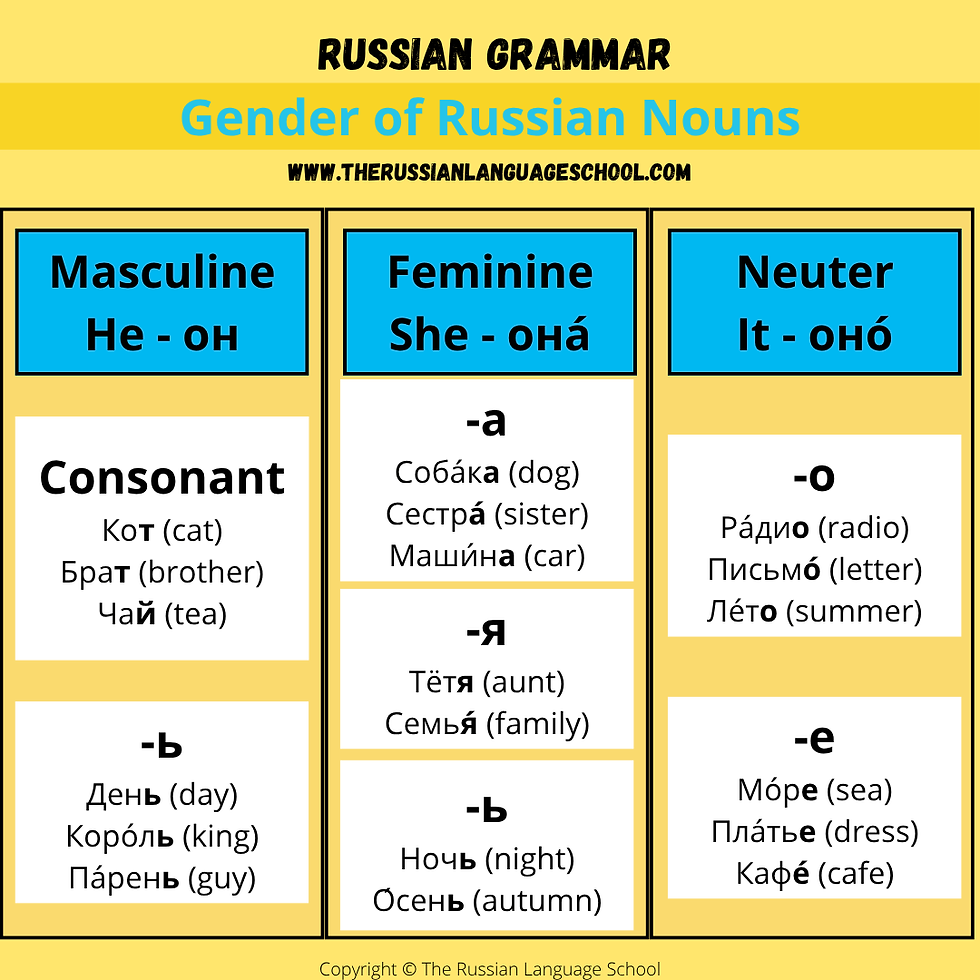
A quick way to guess the gender:
CONSONANT / -Й → MASCULINE
-А / -Я → FEMININE
-О / -Е / -Ё → NEUTER
But be careful with -Ь!
-Ь → masculine OR feminine
Russian Masculine Nouns: Exceptions
While most masculine nouns follow familiar patterns—such as ending in a consonant or -й—there are some important exceptions.
These exceptions are especially useful to learn because some Russian nouns have endings that do not match the gender you might expect. For example, some masculine nouns end in -а or -я, while some masculine indeclinable nouns end in -о, -и, -е or -у.

1. Masculine nouns referring to males
When a noun refers to a male person, its grammatical gender is generally determined by the biological gender of the person, even if the noun has an ending that usually suggests feminine gender.
This includes male names:
Никита — Nikita
Саша — Sasha, a diminutive form of Александр
Many diminutive forms of masculine Russian names end in -а or -я, but they remain masculine because they refer to males.
The same applies to several common nouns referring to male people:
дедушка — grandfather
дядя — uncle
мужчина — man
папа — dad
юноша — young man
Although these nouns end in -а or -я, they are masculine nouns.
For example:
Мой папа работает врачом. - My dad works as a doctor.
Notice that мой is masculine, not feminine, because папа is grammatically masculine.
There are also some occupations and roles that follow this principle:
судья — judge
староста — class monitor / group leader
слуга — servant
When these words refer to a man, they are grammatically masculine:
Он хороший судья. - He is a good judge.
When судья or староста refers to a woman, the grammatical agreement can be feminine:
Она хорошая судья. - She is a good judge.
This is an important example of how the meaning of a noun can influence grammatical agreement.
2. Indeclinable names of cities and islands
Russian also has masculine nouns among indeclinable geographical names — that is, names that do not change their form when they are used in different cases.
Indeclinable geographical names usually take the gender of the generic noun they refer to. When the name refers to a city, it is masculine because город is masculine.
For example:
Калгари — Calgary
Гонолулу — Honolulu
Сан-Тропе — Saint-Tropez
Токио — Tokyo
Баку — Baku
Осло — Oslo
Токио — Tokyo
Мехико — Mexico City
Сочи — Sochi
We can think of the gender as being inherited from the generic word город:
город Токио — the city of Tokyo
Он находится в Токио. — It is located in Tokyo.
Similarly, indeclinable names of islands are masculine because the Russian generic word остров (island) is masculine.
For example:
Капри — Capri
Антигуа — Antigua
Корфу — Corfu
The grammatical gender therefore follows the Russian word associated with the place, rather than the ending of the geographical name itself.
3. Indeclinable animal and bird names
Some nouns referring to animals and birds are borrowed from other languages and do not decline in Russian. Many of these nouns are masculine, even though their endings do not look masculine.
For example:
шимпанзе — chimpanzee
какаду — cockatoo
пони — pony
фламинго — flamingo
For example:
Красивый фламинго стоит у воды. - A beautiful flamingo is standing by the water.
Indeclinable animal names are usually masculine when the sex of the animal is unknown or not important. If the animal is specifically female, feminine agreement may be used.
For example:
большой шимпанзе — a large chimpanzee
молодая шимпанзе — a young female chimpanzee
4. Indeclinable nouns referring to male persons
Borrowed nouns referring specifically to men can also be masculine, even when they end in -е, -и, -о, or another ending that does not resemble a typical masculine noun.
For example:
конферансье — compere / master of ceremonies
рефери — referee
5. Indeclinable nouns referring to non-living things
Some indeclinable nouns referring to objects, concepts, or other non-living things are also masculine. In these cases, their gender is often determined by the gender of a Russian word describing the general category. These are usually foreign words, so their grammatical gender may need to be checked in a dictionary.
For example:
кофе — coffee — masculine
евро — euro — masculine
торнадо — tornado — masculine
пенальти — penalty kick — masculine
хинди — Hindi — masculine
Consider торнадо. The word itself does not have a typical Russian masculine ending, but it is masculine partly because it can be associated with ветер (wind), which is masculine:
сильный торнадо — a strong tornado
Similarly, хинди is masculine because язык (language) is masculine.
Пенальти - eleven-metre penalty kick, masculine because the generic word удар 'kick' is masculine.
Important: Not all indeclinable nouns are masculine. Many are neuter:
метро — metro
такси — taxi
пальто — coat
меню — menu
интервью — interview
Therefore, with indeclinable nouns, it is important to learn the gender of the word rather than relying only on its ending.
Russian Neuter Nouns: Exceptions
Russian neuter nouns are usually easy to recognize. Most neuter nouns in Russian end in -о, -е, or -ё:
окно — window
слово — word
море — sea
поле — field
ружьё — rifle
письмо — letter
However, Russian has several important exceptions. Some neuter nouns have unusual endings, while many borrowed indeclinable nouns have no typical Russian noun ending at all.

1. Neuter Nouns Ending in -я
One of the most important exceptions in Russian noun gender is the group of neuter nouns ending in -я.
There are 10 standard neuter nouns ending in -мя:
Russian | English |
бремя | burden |
время | time |
вымя | udder |
знамя | banner, flag |
имя | name |
пламя | flame |
племя | tribe |
семя | seed |
стремя | stirrup |
темя | crown/top of the head |
These nouns are all neuter, even though they end in -я.
For example:
моё имя — my name
долгое время — a long time
красное знамя — a red banner
яркое пламя — a bright flame
2. The Neuter Noun дитя
The noun дитя (“child”) is another important exception.
Although it ends in -я, дитя is neuter.
For example:
маленькое дитя — a small child
Это дитя очень умное. — This child is very smart.
In contemporary everyday Russian, ребёнок is much more common than дитя. The word дитя is more characteristic of literary, poetic, traditional, or somewhat old-fashioned language.
3. Indeclinable Neuter Nouns
Russian contains many nouns borrowed from other languages that are indeclinable, meaning that they do not change their form in different cases.
For example:
меню — menu
такси — taxi
рагу — ragout, stew
каноэ — canoe
па — dance step
Many indeclinable nouns that refer to inanimate objects are neuter. This is a useful general rule, but it is not absolute: the gender of an indeclinable noun can also depend on its meaning or on an implied generic Russian noun.
Examples
новое меню — a new menu
быстрое такси — a fast taxi
вкусное рагу — delicious ragout
маленькое каноэ — a small canoe
сложное па — a difficult dance step
The nouns themselves do not change:
Я смотрю меню. — I’m looking at the menu.
Мы выбрали меню. —We chose the menu.
Мы говорим о меню. —We are talking about the menu.
The adjective, however, shows the noun’s gender: новое меню
This is an important feature of Russian indeclinable nouns: the noun itself remains unchanged, but agreeing words can show its grammatical gender.
Russian Neuter Noun Exceptions: Quick Reference
Type | Examples | Gender |
Typical nouns ending in -о | окно, слово | neuter |
Typical nouns ending in -е | море, поле | neuter |
Typical nouns ending in -ё | ружьё, бельё | neuter |
Nouns ending in -мя | время, имя, пламя | neuter |
Noun ending in -я | дитя | neuter |
Indeclinable inanimate nouns | меню, такси, рагу, каноэ | usually neuter |
🎯 Why is gender important?
Gender affects other words in the sentence, especially adjectives, pronouns, and past-tense verbs.
Compare:
новый дом — a new house
новая книга — a new book
новое окно — a new window
The adjective changes according to the gender of the noun.
The same happens with the past tense:
Он был дома. — He was at home.
Она была дома. — She was at home.
Оно было дома. — It was at home.
So learning the gender of a noun from the beginning will make Russian grammar much easier later!
✏️ Practice
Exercise 1. What is the gender?
стол
книга
море
время
папа
учитель
семья
кофе
окно
ночь
такси
музей
торнадо
меню
Answers:
masculine
feminine
neuter
neuter
masculine
masculine
feminine
masculine
neuter
feminine
neuter
masculine
masculine
neuter
💡 Remember!
Don't just memorize:
книга = book
Learn:
книга — feminine
This will help you choose the correct adjective, pronoun and verb later.
книга → моя книга → новая книга → книга была интересной
Learning nouns together with their gender is one of the best habits you can develop when learning Russian.
Once you can spot a noun's gender, the next step is forming the plural: read How to Form the Plural in Russian.
👩🏫 Need help with Russian grammar?
Russian grammar can be confusing when you're studying on your own. If you want to understand gender, cases, verb aspects, verbs of motion and other Russian grammar topics step by step, our teachers can help.
At The Russian Language School, you can study Russian through:
Individual lessons tailored to your level and goals
Paired lessons
Group lessons
Speaking Clubs
TORFL exam preparation
Business Russian
You can also book lessons specifically focused on Russian grammar and work on the areas you find most difficult.
👉 Ready to improve your Russian? Explore our lessons and find the format that works best for you.


Comments