


Russian Plural Nouns: How to Form the Plural in Russian

Updated: 2 days ago
Learning how to make nouns plural is an essential part of learning Russian. Fortunately, once you understand the basic rules, forming the plural of many Russian nouns becomes much easier.
In this Russian grammar lesson, we’ll look at how to form the plural of Russian nouns in the nominative case, including the most common endings for masculine, feminine, and neuter nouns.
How to Make Nouns Plural in Russian
In the Russian nominative case, nouns can form their plural using the endings -и, -ы, -я, or -а.
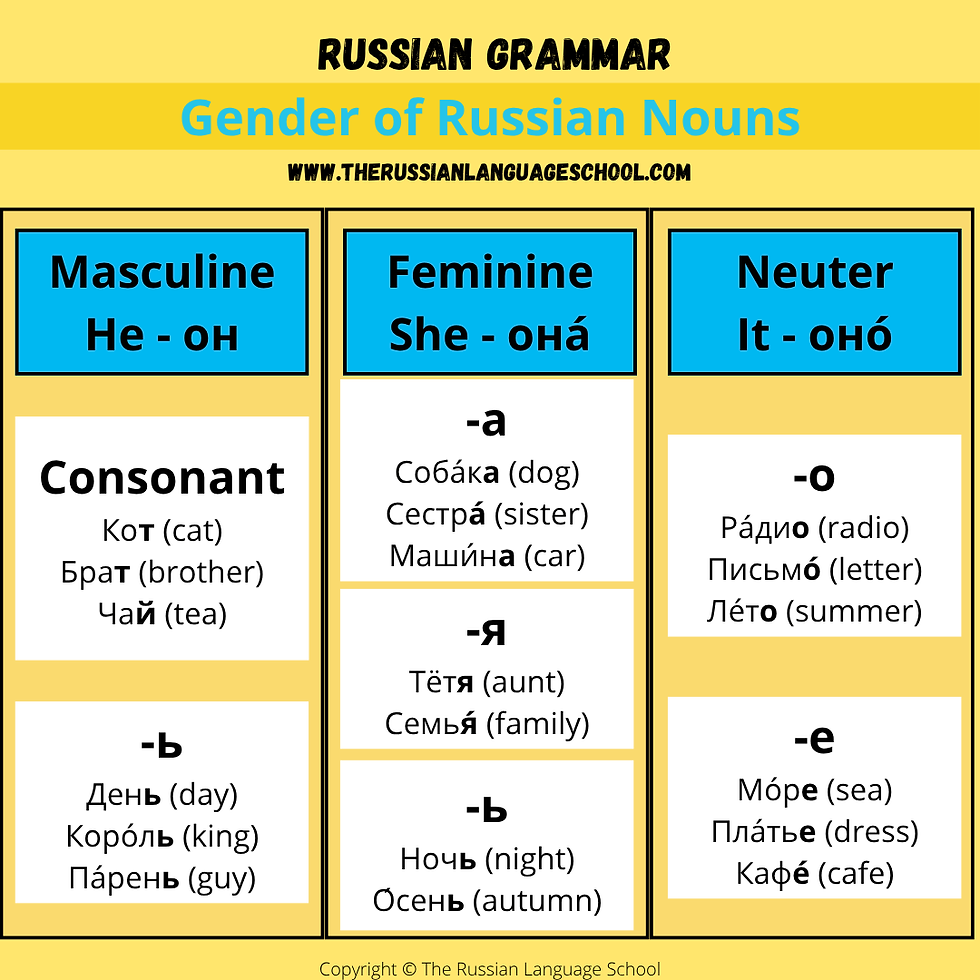
The ending you use depends largely on the gender and ending of the singular noun.
Let’s look at the rules step by step.
Plural of Masculine Nouns
Many masculine nouns in Russian end in a consonant.
1. Consonant + -ы
If a masculine noun ends in a consonant, you generally add -ы to form the plural.
Example:
студент → студенты
student → students
However, there is an important spelling rule to remember. If the final consonant is г, к, х, ж, ч, ш, or щ, you use -и instead of -ы. This is one of the important Russian spelling rules to learn.
For example:
карандаш → карандаши
pencil → pencils
2. Words ending in -й
For masculine nouns ending in -й, replace -й with -и.
For example:
музей → музеи
museum → museums
3. Words ending in -ь
For masculine nouns ending in the soft sign -ь, replace -ь with -и.
For example:
словарь → словари
dictionary → dictionaries
Plural of Feminine Nouns
Many feminine Russian nouns end in -а, -я, or -ь.
1. Words ending in -я
Replace -я with -и.
For example:
неделя → недели
week → weeks
2. Words ending in -ь
Replace -ь with -и.
For example:
тетрадь → тетради
notebook → notebooks
3. Words ending in -а
For feminine nouns ending in -а, replace -а with -ы.
For example:
газета → газеты
newspaper → newspapers
There is an important spelling rule here, too. If the consonant before -а is г, к, х, ж, ч, ш, or щ, use -и rather than -ы.
For example:
книга → книги
book → books
Notice that книгы would be incorrect. Because к is one of the consonants affected by the Russian spelling rule, we use -и.
Plural of Neuter Nouns
Neuter nouns commonly end in -о or -е.
1. Words ending in -о
Replace -о with -а.
For example:
окно → окна
window → windows
2. Words ending in -е
Replace -е with -я.
For example:
здание → здания
building → buildings
Remember to apply the appropriate Russian spelling rules when necessary.
Russian Plural Nouns: Quick Reference
Here is a simple overview of the main rules:
Singular ending | Plural ending | Example |
Masculine consonant | -ы | студент → студенты |
Masculine consonant + spelling rule | -и | мальчик → мальчики |
Masculine -й | -и | музей → музеи |
Masculine -ь | -и | словарь → словари |
Feminine -а | -ы | газета → газеты |
Feminine -а + spelling rule | -и | книга → книги |
Feminine -я | -и | неделя → недели |
Feminine -ь | -и | тетрадь → тетради |
Neuter -о | -а | окно → окна |
Neuter -е | -я | здание → здания |

These examples demonstrate why it is important to look at the gender and ending of the singular noun before forming its plural.
Don’t Forget Russian Spelling Rules
One of the most important things to remember when learning Russian plurals is that -ы cannot be used after certain consonants. After г, к, х, ж, ч, ш, and щ, use -и instead.
This is why:
книга → книги ✅
книга → книгы ❌
And:
мальчик → мальчики ✅
Learning these spelling rules alongside noun endings will help you form Russian plurals correctly and avoid common mistakes.
Practice Makes Perfect
The best way to learn Russian noun plurals is to practise them regularly. When you learn a new Russian noun, try to learn its gender and plural form at the same time.
For example:
студент — студенты
книга — книги
газета — газеты
здание — здания
With regular practice, recognising and forming Russian plural nouns will become much more natural.
Irregular Plural Nouns in Russian
Most Russian nouns form their plural according to regular grammatical rules. However, some common Russian nouns have irregular plural forms that need to be learned individually.
1. Masculine nouns with -а or -я in the plural
Some masculine nouns form their plural with -а or -я. One of the most important irregular patterns is the use of -а or -я instead of the expected -ы or -и. These nouns are especially common in everyday Russian, so learning them early will help you understand and speak Russian more naturally.
For example:
а́дрес → адреса́ — address → addresses
го́род → города́ — city → cities
до́м → дома́ — house → houses
по́езд → поезда́ — train → trains
Notice that the stress moves to the ending in the plural. This is an important feature of these nouns, so it is best to memorize the singular and plural together.
Common masculine nouns with irregular plurals
Singular | Plural | English |
адре́с | адреса́ | address → addresses |
бе́рег | берега́ | shore, bank → shores, banks |
бо́к | бока́ | side → sides |
век | века́ | century → centuries |
ве́чер | вечера́ | evening → evenings |
глаз | глаза́ | eye → eyes |
го́д | года́ | year → years |
го́лос | голоса́ | voice → voices |
го́род | города́ | city → cities |
дире́тор | директора́ | director, principal → directors, principals |
до́ктор | доктора́ | doctor → doctors |
до́м | дома́ | house, home → houses, homes |
колоко́л | колокола́ | bell → bells |
ку́пол | купола́ | dome → domes |
ку́чер | кучера́ | coachman → coachmen |
лес | леса́ | forest → forests |
луг | луга́ | meadow → meadows |
ма́стер | мастера́ | master, specialist → masters, specialists |
мех | меха́ | fur → furs |
но́мер | номера́ | number, room → numbers, rooms |
о́браз | образа́ | icon, holy image → icons |
о́рден | ордена́ | order, medal → orders, medals |
о́стров | острова́ | island → islands |
па́рус | паруса́ | sail → sails |
па́спорт | паспорта́ | passport → passports |
пова́р | повара́ | cook, chef → cooks, chefs |
погре́б | погреба́ | cellar → cellars |
по́езд | поезда́ | train → trains |
по́яс | пояса́ | belt → belts |
прово́д | провода́ | wire → wires |
профе́ссор | профессора́ | professor → professors |
ро́г | рога́ | horn → horns |
сви́тер | сви́тера | sweater → sweaters |
со́рт | сорта́ | type, variety → types, varieties |
том | тома́ | volume → volumes |
тон | тона́ | tone → tones |
то́поль | тополя́ | poplar → poplars |
тор́моз | тормоза́ | brake → brakes |
цвет | цвета́ | color → colors |
учи́тель | учителя́ | teacher → teachers |
я́корь | якоря́ | anchor → anchors |
ла́герь | лагеря́ | camp → camps |
край | края́ | edge, region, land → edges, regions, lands |
штепсе́ль | штепселя́ | plug → plugs |
Why do some Russian masculine nouns have -а/-я instead of -ы/-и?
There is no single rule that allows you to predict every noun that takes -а/-я.
Historically, Russian developed several different plural patterns, and some of these forms became standard parts of modern vocabulary.
As a learner, you don’t need to memorize the historical reasons. What matters is recognizing the pattern and learning the most frequently used nouns.
2. Nouns with two plural forms and different meanings
Some Russian nouns can have two plural forms, but the meaning changes depending on the ending.
These pairs are especially important because using the wrong ending can change the meaning of the word.
Образа́ vs. о́бразы
образа́ — icons, holy images
о́бразы — images, figures, visions
Example:
В це́ркви бы́ли ста́рые образа́. - There were old icons in the church.
But:
В э́том фи́льме интере́сные о́бразы геро́ев. - This film has interesting character portrayals.
Пояса́ vs. по́ясы
пояса́ — belts
по́ясы — geographical belts or zones
Example:
На́деньте пояса́. - Put on your belts.
But:
Земля́ де́лится на климати́ческие по́ясы. - The Earth is divided into climate zones.
Провода́ vs. про́воды
провода́ — wires
про́воды — farewell
Example:
Электри́к прове́рил провода́. - The electrician checked the wires.
But:
Они́ устро́или про́воды дру́га. - They held a farewell for their friend.
Счета́ vs. счёты
счета́ — bills, accounts
счёты — abacus
Example:
Мы получи́ли счета́. - We received the bills.
But:
В ста́рой шко́ле испо́льзовали счёты. - In the old school, they used an abacus.
Тона́ vs. то́ны
тона́ — shades of color
то́ны — tones of sound/voice
Example:
Худо́жник испо́льзовал ра́зные тона́ си́него. - The artist used different shades of blue.
But:
В пе́сне есть высо́кие и ни́зкие то́ны. - There are high and low tones in the song.
Цвета́ vs. цветы́
цвета́ — colors (singular цвет)
цветы — flowers (singular цвето́к)
Example:
Мне нра́вятся э́ти цвета́. - I like these colors.
Мне нра́вятся э́ти цветы́. - I like these flowers.
The most important irregular plurals for beginners
You don’t need to memorize the entire list at once. Start with the words you are most likely to encounter in everyday Russian.
Here is a useful beginner set:

3. Russian Nouns with Irregular Plurals in -ья
Some masculine and neuter nouns form their plural with -ья. Here are some of the most common examples:
Singular | English | Plural |
брат | brother | братья |
друг | friend | друзья |
муж | husband | мужья |
князь | prince | князья |
прут | rod, twig | прутья |
стул | chair | стулья |
сын | son | сыновья |
дерево | tree | деревья |
крыло | wing | крылья |
звено | link | звенья |
полено | log | поленья |
перо | feather | перья |

Practice: Russian Plural Nouns
Now it’s time to practise! Try to make each noun plural using the rules you have learned. Pay attention to the gender and ending of each noun, and remember the Russian spelling rules.
Exercise 1: Make the Noun Plural
Write the plural form of each noun.
студент → __________
мальчик → __________
стол → __________
рубль → __________
книга → __________
брат → __________
город → __________
газета → __________
машина → __________
неделя → __________
друг → __________
тетрадь → __________
доктор → __________
окно → __________
здание → __________
стул → __________
Answers
Exercise 1
студент → студенты
мальчик → мальчики
стол → столы
рубль → рубли
книга → книги
брат → братья
город → города
газета → газеты
машина → машины
неделя → недели
друг → друзья
тетрадь → тетради
доктор → доктора
окно → окна
здание → здания
стул → стулья
Ready to Take Your Russian Further?
Learning Russian grammar is much easier when you have clear explanations, practical exercises, and guidance from experienced teachers.
At The Russian Language School, we help students build their Russian step by step — from essential grammar and vocabulary to confident everyday communication. Our lessons are designed to make Russian easier to understand, practise, and use in real-life situations.
Whether you are a complete beginner or looking to improve your existing Russian, our courses can help you develop your speaking, listening, reading, and writing skills while building a strong foundation in Russian grammar.
Ready to improve your Russian? Explore our Russian language courses and start your learning journey with The Russian Language School today.
Comments